Building Custom PGMs with hamon#
Previous notebooks used the Ising model convenience APIs. This notebook dives into hamon's full abstraction stack, showing you how to build models with:
- Mixed node types (spin + categorical variables in the same model)
- Custom interaction structures via
DiscreteEBMFactor - Automatic graph coloring to derive a correct sampling order
- Observers for efficient on-the-fly statistics
By the end you will understand hamon's layered architecture and be able to build models beyond the standard Ising model.
The hamon abstraction stack#
hamon organizes sampling programs in layers, from high-level model specification to low-level execution:
AbstractNode          -- SpinNode, CategoricalNode
    |
    v
Block                 -- a group of same-type nodes (sampling unit)
    |
    v
AbstractFactor        -- encodes interactions between node groups
    |                    (compiles to InteractionGroups)
    v
InteractionGroup      -- directed head/tail dependency for updates
    |
    v
BlockSamplingProgram  -- complete executable sampling program
The key insight: model specification (nodes, factors) is separate from sampling execution (programs, schedules). You define your model using nodes and factors; hamon compiles this into an efficient sampling program.
Heterogeneous models: mixing node types#
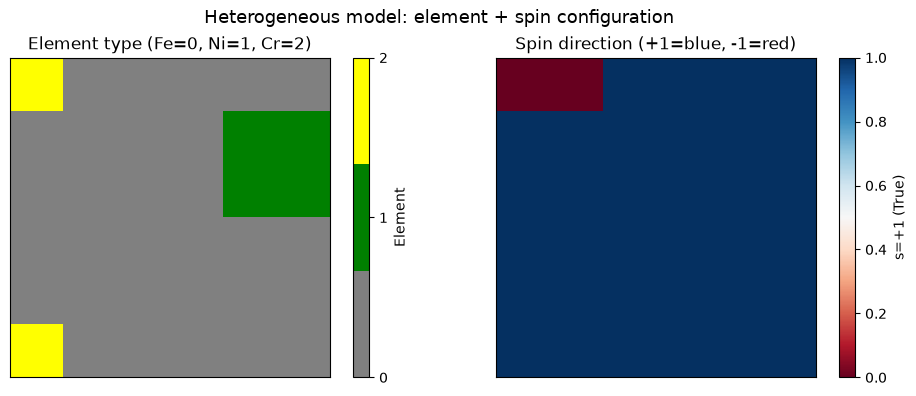
Many scientific models involve multiple types of discrete variables. Consider a simplified alloy model where each lattice site has:
- A spin variable \(s_i \in \{-1, +1\}\) representing the magnetic moment
- A categorical variable \(c_i \in \{0, 1, 2\}\) representing the element type (Fe, Ni, Cr)
The energy includes: - Spin-spin coupling: neighboring magnetic moments interact - Element-element preference: certain element pairs prefer to be neighbors - Spin-element coupling: the magnetic interaction depends on which elements are involved
import jax
import jax.numpy as jnp
import matplotlib.pyplot as plt
import networkx as nx
import numpy as np
from hamon import Block, CategoricalNode, SpinNode
from hamon.models.discrete_ebm import (
    CategoricalEBMFactor,
    CategoricalGibbsConditional,
    DiscreteEBMFactor,
    SpinEBMFactor,
    SpinGibbsConditional,
)
from matplotlib import colors as mcolors

# Grid parameters
ROWS, COLS = 6, 6
N = ROWS * COLS
N_ELEMENTS = 3  # Fe=0, Ni=1, Cr=2

# Create nodes: one spin + one categorical per site
spin_nodes = [[SpinNode() for _ in range(COLS)] for _ in range(ROWS)]
cat_nodes = [[CategoricalNode() for _ in range(COLS)] for _ in range(ROWS)]

flat_spins = [spin_nodes[r][c] for r in range(ROWS) for c in range(COLS)]
flat_cats = [cat_nodes[r][c] for r in range(ROWS) for c in range(COLS)]

print(f"Model: {N} sites, each with 1 spin + 1 categorical variable")
print(f"Total variables: {2 * N}")
# Build edge lists (nearest-neighbor)
G = nx.grid_2d_graph(ROWS, COLS)
edges = list(G.edges())
n_edges = len(edges)

# Factor 1: Spin-spin pairwise coupling
# E_ss = -sum J_ss * s_i * s_j
spin_heads = [spin_nodes[r1][c1] for (r1, c1), (r2, c2) in edges]
spin_tails = [spin_nodes[r2][c2] for (r1, c1), (r2, c2) in edges]
J_ss = jnp.ones(n_edges) * 0.1  # uniform ferromagnetic coupling
factor_ss = SpinEBMFactor(
    [Block(spin_heads), Block(spin_tails)],
    J_ss,
)

# Factor 2: Element-element pairwise preference
# E_cc = -sum W_cc[c_i, c_j] (favors like-element neighbors)
cat_heads = [cat_nodes[r1][c1] for (r1, c1), (r2, c2) in edges]
cat_tails = [cat_nodes[r2][c2] for (r1, c1), (r2, c2) in edges]
# Weight tensor: like elements get +1, unlike get -0.2
W_cc_single = jnp.where(
    jnp.eye(N_ELEMENTS, dtype=jnp.bool_),
    1.0,
    -0.2,
)
W_cc = jnp.tile(W_cc_single, (n_edges, 1, 1))
factor_cc = CategoricalEBMFactor(
    [Block(cat_heads), Block(cat_tails)],
    W_cc,
)

# Factor 3: Spin-element coupling (mixed factor!)
# E_sc = -sum s_i * W_sc[c_i]  (magnetic moment depends on element type)
# Fe is more magnetic, Cr less so
W_sc_single = jnp.array([1.0, 0.5, 0.1])  # Fe, Ni, Cr magnetic coupling
W_sc = jnp.tile(W_sc_single, (N, 1))  # per-site
factor_sc = DiscreteEBMFactor(
    spin_node_groups=[Block(flat_spins)],
    categorical_node_groups=[Block(flat_cats)],
    weights=W_sc,
)

all_factors = [factor_ss, factor_cc, factor_sc]
print(f"Factors: spin-spin ({n_edges}), cat-cat ({n_edges}), spin-cat ({N})")
# Build blocks via graph coloring on the spatial graph
coloring = nx.coloring.greedy_color(G, strategy="DSATUR")
n_graph_colors = max(coloring.values()) + 1

# Each spatial color group produces TWO blocks: one for spins, one for cats
spin_color_groups = [[] for _ in range(n_graph_colors)]
cat_color_groups = [[] for _ in range(n_graph_colors)]
for (r, c), color in coloring.items():
    spin_color_groups[color].append(spin_nodes[r][c])
    cat_color_groups[color].append(cat_nodes[r][c])

# Flat list of all free blocks (spin blocks first within each color, then cat)
all_free_blocks = []
for i in range(n_graph_colors):
    all_free_blocks.append(Block(spin_color_groups[i]))
    all_free_blocks.append(Block(cat_color_groups[i]))

print(f"Graph colors: {n_graph_colors}")
print(
    f"Total free blocks: {len(all_free_blocks)} ({n_graph_colors} spin + {n_graph_colors} cat)"
)
Deriving the sampling order by graph coloring#
Manually working out which blocks may be updated together is error-prone. The rule is a property of the interaction graph: two blocks conflict when one appears as a tail (neighbor) of an interaction whose head lies in the other. Block Gibbs requires every block in a sampling group to read the same global-state snapshot, so updating one of a conflicting pair would corrupt the input the other reads.
That makes the sampling order a graph-coloring problem on the conflict graph, and each
color class becomes one sampling group. hamon.graph_utils.rlf_coloring — the same
routine hamon uses internally for Ising lattices — does the coloring; fewer colors means
fewer sequential write-back barriers per sweep.
from collections import defaultdict

from hamon.graph_utils import rlf_coloring

# Compile all factors to interaction groups
all_igs = []
for f in all_factors:
    all_igs.extend(f.to_interaction_groups())


def color_blocks(free_blocks, interaction_groups):
    """Group blocks into sampling groups that can be updated simultaneously."""
    # Which block owns each node?
    node_to_block = {
        node: bi for bi, block in enumerate(free_blocks) for node in block.nodes
    }

    # Two blocks conflict if an interaction puts one in the head and the other
    # in a tail. The relation is symmetric: if A feeds B then neither ordering
    # is safe within a single group.
    conflicts = set()
    for ig in interaction_groups:
        heads = {node_to_block[n] for n in ig.head_nodes.nodes if n in node_to_block}
        tails = {
            node_to_block[n]
            for tail_block in ig.tail_nodes
            for n in tail_block.nodes
            if n in node_to_block
        }
        for h in heads:
            for t in tails:
                if h != t:
                    conflicts.add((h, t))
                    conflicts.add((t, h))

    colors = rlf_coloring(len(free_blocks), conflicts)

    # Ascending block index preserves the original ordering within each group.
    groups = defaultdict(list)
    for bi, color in enumerate(colors):
        groups[color].append(free_blocks[bi])
    return [g[0] if len(g) == 1 else tuple(g) for _, g in sorted(groups.items())]


super_blocks = color_blocks(all_free_blocks, all_igs)

print(f"coloring produced {len(super_blocks)} super-blocks:")
for i, sb in enumerate(super_blocks):
    if isinstance(sb, Block):
        print(f"  Group {i}: 1 block ({len(sb)} nodes, type={sb.node_type.__name__})")
    else:
        types = [b.node_type.__name__ for b in sb]
        sizes = [len(b) for b in sb]
        print(f"  Group {i}: {len(sb)} blocks (sizes={sizes}, types={types})")
coloring produced 4 super-blocks:
  Group 0: 1 block (18 nodes, type=SpinNode)
  Group 1: 1 block (18 nodes, type=CategoricalNode)
  Group 2: 1 block (18 nodes, type=SpinNode)
  Group 3: 1 block (18 nodes, type=CategoricalNode)
# Build the full sampling program
from hamon import BlockGibbsSpec, SamplingSchedule, sample_states
from hamon.factor import FactorSamplingProgram

node_sd = {
    SpinNode: jax.ShapeDtypeStruct((), jnp.bool_),
    CategoricalNode: jax.ShapeDtypeStruct((), jnp.uint8),
}

spec = BlockGibbsSpec(super_blocks, clamped_blocks=[], node_shape_dtypes=node_sd)

# Assign the right conditional sampler to each free block
samplers = []
for block in spec.free_blocks:
    if block.node_type is SpinNode:
        samplers.append(SpinGibbsConditional())
    else:
        samplers.append(CategoricalGibbsConditional(n_categories=N_ELEMENTS))

program = FactorSamplingProgram(spec, samplers, all_factors, [])

print(
    f"Sampling program: {len(spec.free_blocks)} free blocks, {len(spec.sampling_order)} sequential groups"
)
# Initialize and sample
key = jax.random.key(42)

init_state = []
for i, block in enumerate(spec.free_blocks):
    k = jax.random.fold_in(key, i)
    if block.node_type is SpinNode:
        init_state.append(
            jax.random.bernoulli(k, shape=(len(block),)).astype(jnp.bool_)
        )
    else:
        init_state.append(
            jax.random.randint(
                k, shape=(len(block),), minval=0, maxval=N_ELEMENTS
            ).astype(jnp.uint8)
        )

schedule = SamplingSchedule(n_warmup=200, n_samples=800, steps_per_sample=5)

# Observe both spin and categorical states
obs_blocks = [Block(flat_spins), Block(flat_cats)]
key, subkey = jax.random.split(key)
results = sample_states(subkey, program, schedule, init_state, [], obs_blocks)
spin_samples, cat_samples = results

print(f"Spin samples: {spin_samples.shape}")
print(f"Cat samples:  {cat_samples.shape}")
# Visualize a sampled configuration: element type + spin direction
sample_idx = -1  # last sample
element_grid = np.array(cat_samples[sample_idx]).reshape(ROWS, COLS)
spin_grid = np.array(spin_samples[sample_idx]).reshape(ROWS, COLS).astype(float)

fig, axes = plt.subplots(1, 2, figsize=(10, 4))

# Element types
colors = ["gray", "green", "yellow"]
cmap_elem = mcolors.ListedColormap(colors)
im0 = axes[0].imshow(
    element_grid, cmap=cmap_elem, vmin=0, vmax=N_ELEMENTS - 1, interpolation="nearest"
)
axes[0].set_title("Element type (Fe=0, Ni=1, Cr=2)")
axes[0].set_xticks([])
axes[0].set_yticks([])
plt.colorbar(im0, ax=axes[0], ticks=[0, 1, 2], label="Element")

# Spin directions
im1 = axes[1].imshow(spin_grid, cmap="RdBu", vmin=0, vmax=1, interpolation="nearest")
axes[1].set_title("Spin direction (+1=blue, -1=red)")
axes[1].set_xticks([])
axes[1].set_yticks([])
plt.colorbar(im1, ax=axes[1], label="s=+1 (True)")

fig.suptitle("Heterogeneous model: element + spin configuration", fontsize=13)
plt.tight_layout()
plt.show()
InteractionGroups under the hood#
Each factor compiles into one or more InteractionGroup objects. An InteractionGroup specifies:
- head_nodes: the block being updated
- tail_nodes: the neighbor blocks whose state is read during the update
- interaction: the PyTree of parameters (e.g., weight tensors) governing the update
Let's inspect what the spin-spin factor produces.
# Inspect interaction groups from the spin-spin factor
ss_igs = factor_ss.to_interaction_groups()
print(f"Spin-spin factor produces {len(ss_igs)} InteractionGroup(s)")
for i, ig in enumerate(ss_igs):
    print(f"  IG {i}:")
    print(
        f"    Head nodes: {len(ig.head_nodes)} (type: {ig.head_nodes.node_type.__name__})"
    )
    print(f"    Tail blocks: {len(ig.tail_nodes)}")
    for j, tb in enumerate(ig.tail_nodes):
        print(f"      Tail {j}: {len(tb)} nodes (type: {tb.node_type.__name__})")
    print(f"    Interaction weights shape: {ig.interaction.weights.shape}")
Spin-spin factor produces 1 InteractionGroup(s)
  IG 0:
    Head nodes: 120 (type: SpinNode)
    Tail blocks: 1
      Tail 0: 120 nodes (type: SpinNode)
    Interaction weights shape: (120,)
# The mixed factor (spin-element coupling) is more interesting
sc_igs = factor_sc.to_interaction_groups()
print(f"\nSpin-cat factor produces {len(sc_igs)} InteractionGroup(s)")
for i, ig in enumerate(sc_igs):
    print(f"  IG {i}:")
    print(f"    Head: {len(ig.head_nodes)} {ig.head_nodes.node_type.__name__} nodes")
    for j, tb in enumerate(ig.tail_nodes):
        print(f"    Tail {j}: {len(tb)} {tb.node_type.__name__} nodes")
    print(f"    Weights shape: {ig.interaction.weights.shape}")
Spin-cat factor produces 2 InteractionGroup(s)
  IG 0:
    Head: 36 SpinNode nodes
    Tail 0: 36 CategoricalNode nodes
    Weights shape: (36, 3)
  IG 1:
    Head: 36 CategoricalNode nodes
    Tail 0: 36 SpinNode nodes
    Weights shape: (36, 3)
The DiscreteEBMFactor for the spin-cat coupling generates separate interaction groups: one where spins are the head (updated) and categories are the tail (read), and one where categories are the head and spins are the tail. This ensures both variable types are correctly updated.
Observers: monitoring the chain#
Storing all samples can be expensive for large models. hamon's observers compute running statistics during sampling without storing every sample.
The MomentAccumulatorObserver accumulates products of state variables — perfect for computing first moments (marginals) and second moments (correlations).
from hamon import sample_with_observation
from hamon.observers import MomentAccumulatorObserver

# Define what moments we want:
# - First moments: marginal of each spin
# - Second moments: correlation between neighboring spins
first_moment_nodes = [(s,) for s in flat_spins]  # each spin individually
second_moment_pairs = [
    (spin_nodes[r1][c1], spin_nodes[r2][c2]) for (r1, c1), (r2, c2) in edges
]

moment_spec = [first_moment_nodes, second_moment_pairs]


# Transform: map boolean -> spin value {-1, +1}
def spin_transform(state, blocks):
    return [2 * x.astype(jnp.int8) - 1 for x in state]


observer = MomentAccumulatorObserver(moment_spec, spin_transform)
init_mem = observer.init()

# Run sampling with the observer
key, subkey = jax.random.split(key)
schedule_obs = SamplingSchedule(n_warmup=300, n_samples=1000, steps_per_sample=2)

# Re-initialize
init_state_obs = []
for i, block in enumerate(spec.free_blocks):
    k = jax.random.fold_in(key, i + 100)
    if block.node_type is SpinNode:
        init_state_obs.append(
            jax.random.bernoulli(k, shape=(len(block),)).astype(jnp.bool_)
        )
    else:
        init_state_obs.append(
            jax.random.randint(
                k, shape=(len(block),), minval=0, maxval=N_ELEMENTS
            ).astype(jnp.uint8)
        )

moments, _ = sample_with_observation(
    subkey, program, schedule_obs, init_state_obs, [], init_mem, observer
)

# Extract and normalize
node_sums, edge_sums = moments
node_moments = node_sums / schedule_obs.n_samples
edge_moments = edge_sums / schedule_obs.n_samples

print(f"First moments (spin marginals): shape {node_moments.shape}")
print(f"  Mean ⟨sᵢ⟩: {float(jnp.mean(node_moments)):.4f}")
print(f"  Std:        {float(jnp.std(node_moments)):.4f}")
print(f"\nSecond moments (correlations): shape {edge_moments.shape}")
print(f"  Mean ⟨sᵢsⱼ⟩: {float(jnp.mean(edge_moments)):.4f}")
First moments (spin marginals): shape (36,)
  Mean ⟨sᵢ⟩: 0.8303
  Std:        0.0395

Second moments (correlations): shape (60,)
  Mean ⟨sᵢsⱼ⟩: 0.7135
# Compare observer estimates with empirical averages from stored samples
# (We already have spin_samples from earlier)
spin_vals = 2 * spin_samples.astype(jnp.float32) - 1
empirical_marginals = jnp.mean(spin_vals, axis=0)

fig, ax = plt.subplots(figsize=(6, 5))
ax.scatter(
    np.array(empirical_marginals),
    np.array(node_moments),
    alpha=0.6,
    s=30,
    color="steelblue",
)

# Auto-scale axis to data range with padding
all_vals = np.concatenate([np.array(empirical_marginals), np.array(node_moments)])
vmin, vmax = float(all_vals.min()), float(all_vals.max())
pad = max(0.05, (vmax - vmin) * 0.1)
ax.plot(
    [vmin - pad, vmax + pad], [vmin - pad, vmax + pad], "--", color="gray", alpha=0.5
)
ax.set_xlim(vmin - pad, vmax + pad)
ax.set_ylim(vmin - pad, vmax + pad)

ax.set_xlabel("Empirical marginals (from stored samples)")
ax.set_ylabel("Observer marginals (running accumulation)")
ax.set_title("Observer vs empirical moment estimates")
ax.set_aspect("equal")
plt.tight_layout()
plt.show()

# Note: these use different random seeds, so they won't match exactly
# but should show the same statistical pattern
print("Both estimators agree on the statistical pattern.")
print(
    "The MomentAccumulatorObserver avoids storing all samples — critical for large models."
)
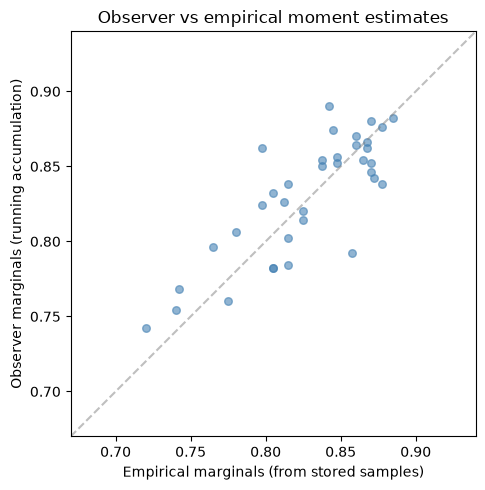
Both estimators agree on the statistical pattern.
The MomentAccumulatorObserver avoids storing all samples — critical for large models.
Summary#
- hamon's abstraction stack separates model definition (Nodes, Factors) from sampling execution (Programs)
- Heterogeneous models with mixed node types (spin + categorical) are built using
DiscreteEBMFactor - Each factor compiles to InteractionGroups that specify head/tail dependencies
- Coloring the conflict graph derived from the interaction groups determines which blocks can be updated simultaneously
- Observers like
MomentAccumulatorObservercollect running statistics without storing all samples
Next: how do we know if our samples are any good? Notebook 04 covers diagnostics for sample quality.